

Chemical Formula For Magnesium Iodide
 Aluminium trichloride hexahydrate, pure (height), and contaminated with iron(III) chloride (bottom) | |||
| |||
| Names | |||
|---|---|---|---|
| IUPAC name Aluminium chloride | |||
| Other names Aluminium(III) chloride | |||
| Identifiers | |||
| CAS Number |
| ||
| 3D model (JSmol) |
| ||
| ChEBI |
| ||
| ChemSpider |
| ||
| ECHA InfoCard | 100.028.371 | ||
| EC Number |
| ||
| Gmelin Reference | 1876 | ||
| PubChem CID |
| ||
| RTECS number |
| ||
| UNII |
| ||
| CompTox Dashboard (EPA) |
| ||
| InChI
| |||
| SMILES
| |||
| Properties | |||
| Chemic formula | AlCl3 | ||
| Molar mass |
| ||
| Appearance | Colourless crystals, hygroscopic | ||
| Density |
| ||
| Melting point |
| ||
| Solubility in water |
| ||
| Solubility |
| ||
| Vapor pressure |
| ||
| Viscosity |
| ||
| Construction | |||
| Crystal structure | Monoclinic, mS16 | ||
| Space group | C12/m1, No. 12[3] | ||
| Lattice constant | a = 0.591 nm, b = 0.591 nm, c = 1.752 nm[three] | ||
| Lattice book (V) | 0.52996 nm3 | ||
| Formula units (Z) | 6 | ||
| Coordination geometry | Octahedral (solid) Tetrahedral (liquid) | ||
| Molecular shape | Trigonal planar (monomeric vapour) | ||
| Thermochemistry | |||
| Heat chapters (C) | 91.1 J/(mol·K)[4] | ||
| Std molar | 109.three J/(mol·K)[iv] | ||
| Std enthalpy of | −704.2 kJ/mol[4] | ||
| Gibbs costless energy (Δf G ⦵) | −628.viii kJ/mol[4] | ||
| Pharmacology | |||
| ATC code | D10AX01 (WHO) | ||
| Hazards | |||
| GHS labelling:[6] | |||
| Pictograms |  | ||
| Indicate word | Danger | ||
| Run a risk statements | H314 | ||
| Precautionary statements | P260, P280, P301+P330+P331, P303+P361+P353, P305+P351+P338+P310, P310 | ||
| NFPA 704 (burn down diamond) | 3 0 2 | ||
| Lethal dose or concentration (LD, LC): | |||
| LD50 (median dose) | 380 mg/kg, rat (oral, anhydrous) 3311 mg/kg, rat (oral, hexahydrate) | ||
| NIOSH (US health exposure limits): | |||
| PEL (Permissible) | None[five] | ||
| REL (Recommended) | 2 mg/k3 [5] | ||
| IDLH (Immediate danger) | N.D.[v] | ||
| Related compounds | |||
| Other anions |
| ||
| Other cations |
| ||
| Related Lewis acids |
| ||
| Supplementary information page | |||
| Aluminium chloride (information folio) | |||
| Except where otherwise noted, data are given for materials in their standard state (at 25 °C [77 °F], 100 kPa). Infobox references | |||


Aluminium chloride, also known as aluminium trichloride, is an inorganic compound with the formula AlCliii . It forms hexahydrate with the formula [Al(HtwoO)vi]Cl3 , containing 6 water molecules of hydration. Both are colourless crystals, but samples are often contaminated with iron(Three) chloride, giving a yellow color.
The anhydrous material is important commercially. It has a low melting and boiling point. It is mainly produced and consumed in the production of aluminium metal, but big amounts are also used in other areas of the chemical industry.[7] The compound is often cited as a Lewis acid. It is an case of an inorganic chemical compound that reversibly changes from a polymer to a monomer at mild temperature.
Construction [edit]
Anhydrous [edit]
AlCl3 adopts iii structures, depending on the temperature and the land (solid, liquid, gas). Solid AlClthree has a sheet-like layered structure with cubic close-packed chloride ions. In this framework, the Al centres exhibit octahedral coordination geometry.[viii] Yttrium(Iii) chloride adopts the same construction, as practice a range of other compounds. When aluminium trichloride is in its melted country, information technology exists as the dimer Al2Clvi , with tetracoordinate aluminium. This change in structure is related to the lower density of the liquid phase (1.78 g/cm3) versus solid aluminium trichloride (two.48 g/cm3). Al2Clsix dimers are as well institute in the vapour phase. At higher temperatures, the Al2Clhalf dozen dimers dissociate into trigonal planar AlCl3 monomer, which is structurally coordinating to BFthree . The melt conducts electricity poorly,[9] unlike more ionic halides such as sodium chloride.
Aluminium chloride monomer belongs to the point group D3h in its monomeric form and D2h in its dimeric form.
Hexahydrate [edit]

The hexahydrate consists of octahedral [Al(H2O)6]3+ cation centers and chloride anions (Cl− ) as counterions. Hydrogen bonds link the cation and anions.[10] The hydrated form of aluminium chloride has an octahedral molecular geometry, with the central aluminium ion surrounded past vi water ligand molecules. Being coordinatively saturated, the hydrate is of little value as a goad in Friedel-Crafts alkylation and related reactions.
Uses [edit]
Alkylation and acylation of arenes [edit]
AlCl3 is a common Lewis-acid catalyst for Friedel-Crafts reactions, both acylations and alkylations.[xi] Of import products are detergents and ethylbenzene. These types of reactions are the major use for aluminium chloride, for example, in the preparation of anthraquinone (used in the dyestuffs industry) from benzene and phosgene.[nine] In the full general Friedel-Crafts reaction, an acyl chloride or alkyl halide reacts with an aromatic system as shown:[eleven]

The alkylation reaction is more than widely used than the acylation reaction, although its practice is more technically demanding. For both reactions, the aluminium chloride, besides every bit other materials and the equipment, should be dry, although a trace of moisture is necessary for the reaction to proceed.[12] Detailed procedures are available for alkylation[13] and acylation[fourteen] [15] of arenes.
A general trouble with the Friedel-Crafts reaction is that the aluminium chloride catalyst sometimes is required in full stoichiometric quantities, considering it complexes strongly with the products. This complication sometimes generates a large amount of corrosive waste. For these and similar reasons, the apply of aluminium chloride has oft been displaced by zeolites.[seven]
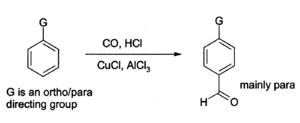
Aluminium chloride can also be used to introduce aldehyde groups onto effluvious rings, for instance via the Gattermann-Koch reaction which uses carbon monoxide, hydrogen chloride and a copper(I) chloride co-goad.[sixteen]
Other applications in organic and organometallic synthesis [edit]
Aluminium chloride finds a wide variety of other applications in organic chemistry.[17] For instance, it tin can catalyse the "ene reaction", such every bit the addition of 3-buten-2-one (methyl vinyl ketone) to carvone:[18]

It is used to induce a diverseness of hydrocarbon couplings and rearrangements.[19] [20]
Aluminium chloride combined with aluminium in the presence of an arene tin can exist used to synthesize bis(arene) metal complexes, e.g. bis(benzene)chromium, from certain metal halides via the and so-chosen Fischer-Hafner synthesis. Dichlorophenylphosphine is prepared past reaction of benzene and phosphorus trichloride catalyzed by aluminium chloride.[21]
Reactions [edit]
Anhydrous aluminium chloride is a powerful Lewis acid, capable of forming Lewis acid-base adducts with even weak Lewis bases such equally benzophenone and mesitylene.[eleven] It forms tetrachloroaluminate ([AlCl4]− ) in the presence of chloride ions.
Aluminium chloride reacts with calcium and magnesium hydrides in tetrahydrofuran forming tetrahydroaluminates.
Reactions with water [edit]
Anhydrous aluminium chloride is hygroscopic, having a very pronounced affinity for h2o. It fumes in moist air and hisses when mixed with liquid h2o as the Cl− ligands are displaced with HiiO molecules to course the hexahydrate [Al(HtwoO)six]Clthree . The anhydrous phase cannot be regained on heating the hexahydrate. Instead HCl is lost leaving aluminium hydroxide or alumina (aluminium oxide):
- [Al(H2O)6]Cl3 → Al(OH)3 + 3 HCl + iii HiiO
Like metal aquo complexes, aqueous AlCl3 is acidic owing to the ionization of the aquo ligands:
- [Al(HtwoO)vi]iii+ ⇌ [Al(OH)(HtwoO)5]ii+ + H+
Aqueous solutions acquit similarly to other aluminium salts containing hydrated Al3+ ions, giving a gelatinous precipitate of aluminium hydroxide upon reaction with dilute sodium hydroxide:
- AlCliii + three NaOH → Al(OH)iii + three NaCl
Synthesis [edit]
Aluminium chloride is manufactured on a large scale past the exothermic reaction of aluminium metal with chlorine or hydrogen chloride at temperatures between 650 to 750 °C (1,202 to 1,382 °F).[9]
- 2 Al + iii Cltwo → 2 AlCl3
- two Al + 6 HCl → two AlCl3 + 3 H2
Aluminum chloride may be formed via a unmarried displacement reaction betwixt copper chloride and aluminum metallic.
- 2 Al + three CuCl2 → 2 AlCl3 + three Cu
In the US in 1993, approximately 21,000 tons were produced, non counting the amounts consumed in the product of aluminium.[seven]
Hydrated aluminium trichloride is prepared by dissolving aluminium oxides in hydrochloric acid. Metallic aluminum also readily dissolves in hydrochloric acid ─ releasing hydrogen gas and generating considerable oestrus. Heating this solid does not produce anhydrous aluminium trichloride, the hexahydrate decomposes to aluminium hydroxide when heated:
- [Al(HiiO)6]Clthree → Al(OH)3 + iii HCl + three HiiO
Aluminium also forms a lower chloride, aluminium(I) chloride (AlCl), just this is very unstable and only known in the vapour stage.[9]
Natural occurrence [edit]
Anhydrous aluminum chloride is not found as a mineral. The hexahydrate, notwithstanding, is known equally the rare mineral chloraluminite.[22] A more than circuitous, basic and hydrated aluminum chloride mineral is cadwaladerite.[23] [22]
Safe [edit]
Anhydrous AlCl3 reacts vigorously with bases, so suitable precautions are required. It tin can cause irritation to the eyes, pare, and the respiratory system if inhaled or on contact.[24]
Run into also [edit]
- Aluminium monochloride
References [edit]
- ^ a b c d Haynes, William Grand., ed. (2011). CRC Handbook of Chemical science and Physics (92nd ed.). Boca Raton, FL: CRC Printing. p. four.45. ISBN1-4398-5511-0.
- ^ a b Aluminum chloride Archived 2014-05-05 at the Wayback Machine. Chemister.ru (2007-03-19). Retrieved on 2017-03-17.
- ^ a b Ketelaar, J. A. A. (1935). "Die Kristallstruktur der Aluminiumhalogenide II". Zeitschrift für Kristallographie – Crystalline Materials. 90 (1–6): 237–255. doi:ten.1524/zkri.1935.90.one.237. S2CID 100796636.
- ^ a b c d Haynes, William Chiliad., ed. (2011). CRC Handbook of Chemistry and Physics (92nd ed.). Boca Raton, FL: CRC Printing. p. v.5. ISBN1-4398-5511-0.
- ^ a b c NIOSH Pocket Guide to Chemic Hazards. "#0024". National Institute for Occupational Safety and Health (NIOSH).
- ^ Sigma-Aldrich Co., Aluminum chloride.
- ^ a b c Helmboldt, Otto; Keith Hudson, L.; Misra, Chanakya; Wefers, Karl; Heck, Wolfgang; Stark, Hans; Danner, Max; Rösch, Norbert (2007). "Aluminum Compounds, Inorganic". Ullmann'south Encyclopedia of Industrial Chemical science. Weinheim: Wiley-VCH. doi:x.1002/14356007.a01_527.pub2.
- ^ In dissimilarity, AlBr3 has a more molecular structure, with the Al3+ centers occupying adjacent tetrahedral holes of the close-packed framework of Br− ions. Wells, A. F. (1984) Structural Inorganic Chemistry, Oxford Press, Oxford, United Kingdom. ISBN 0198553706.
- ^ a b c d Greenwood, Norman N.; Earnshaw, Alan (1984). Chemistry of the Elements. Oxford: Pergamon Press. ISBN978-0-08-022057-4.
- ^ Andress, Yard.R.; Carpenter, C. (1934). "Kristallhydrate Two. Die Struktur von Chromchlorid- und Aluminiumchloridhexahydrat". Zeitschrift für Kristallographie – Crystalline Materials. 87. doi:10.1524/zkri.1934.87.1.446.
- ^ a b c Olah, G. A., ed. (1963). Friedel-Crafts and Related Reactions. Vol. one. New York Metropolis: Interscience.
- ^ Nenitzescu, Costin D.; Cantuniari, Ion P. (1933). "Durch Aluminiumchlorid Katalysierte Reaktion, Vi. Mitteil.: Dice Umlagerung des Cyclohexans in Metyl-cyclopentan". Berichte der Deutschen Chemischen Gesellschaft (A and B Series). 66 (8): 1097–1100. doi:10.1002/cber.19330660817. ISSN 1099-0682.
- ^ Jonathan T. Reeves; Zhulin Tan; Daniel R. Fandrick; Jinhua J. Song; Nathan M. Yee; Chris H. Senanayake (2012). "Synthesis of Trifluoromethyl Ketones from Carboxylic Acids: 4-(3,4-Dibromophenyl)-1,1,1-trifluoro-4-methylpentan-2-one". Organic Syntheses. 89: 210. doi:10.15227/orgsyn.089.0210.
- ^ Kamil Paruch; Libor Vyklicky; Thomas J. Katz (2003). "Training of 9,x-Dimethoxyphenanthrene and 3,half dozen-Diacetyl-nine,10-Dimethoxyphenanthrene". Organic Syntheses. fourscore: 227. doi:10.15227/orgsyn.080.0227.
- ^ Alexander J. Seed; Vaishali Sonpatki; Marking R. Herbert (2002). "iii-(4-Bromobenzoyl)propanoic Acid". Organic Syntheses. 79: 204. doi:10.15227/orgsyn.079.0204.
- ^ Wade, L. G. (2003) Organic Chemistry, fifth edition, Prentice Hall, Upper Saddle River, New Bailiwick of jersey, Us. ISBN 013033832X.
- ^ Galatsis, P. (1999) Handbook of Reagents for Organic Synthesis: Acidic and Bones Reagents, H. J. Reich, J. H. Rigby (eds.) Wiley, New York City. pp. 12–15. ISBN 978-0-471-97925-viii.
- ^ Snider, B. B. (1980). "Lewis-acrid catalyzed ene reactions". Acc. Chem. Res. 13 (11): 426. doi:10.1021/ar50155a007.
- ^ Reuben D. Rieke; Stephen E. Bales; Phillip M. Hudnall; Timothy P. Burns; Graham S. Poindexter (1979). "Highly Reactive Magnesium for the Preparation of Grignard Reagents: 1-Norbornanecarboxylic Acid". Organic Syntheses. 59: 85. doi:10.15227/orgsyn.059.0085.
- ^ Sami A. Shama; Carl C. Wamser (1983). "Hexamethyl Dewar Benzene". Organic Syntheses. 61: 62. doi:10.15227/orgsyn.061.0062.
- ^ B. Buchner; L. B. Lockhart Jr. (1951). "Phenyldichlorophosphine". Organic Syntheses. 31: 88. doi:ten.15227/orgsyn.031.0088.
- ^ a b "Listing of Minerals". www.ima-mineralogy.org. International Mineralogical Clan. March 21, 2011.
- ^ "Cadwaladerite". www.mindat.org.
- ^ Aluminum Chloride. solvaychemicals.us
External links [edit]
- International Chemic Safety Card 1125
- Index of Organic Synthesis procedures that utilize AlCl3
- The menstruum iii chlorides
- MSDS Archived 2011-07-22 at the Wayback Machine
- Regime of Canada Fact Sheets and Oftentimes Asked Questions: Aluminum Salts

Chemical Formula For Magnesium Iodide,
Source: https://en.wikipedia.org/wiki/Aluminium_chloride
Posted by: thomasdeeng1986.blogspot.com
0 Response to "Chemical Formula For Magnesium Iodide"
Post a Comment